AI Jobs for Designers: 7 Realistic Career Paths in 2026
Explore seven realistic AI-adjacent career paths for designers, from AI product design to conversation design, research, systems, and enablement.
Ian Cummings
2x Founder, Game Developer
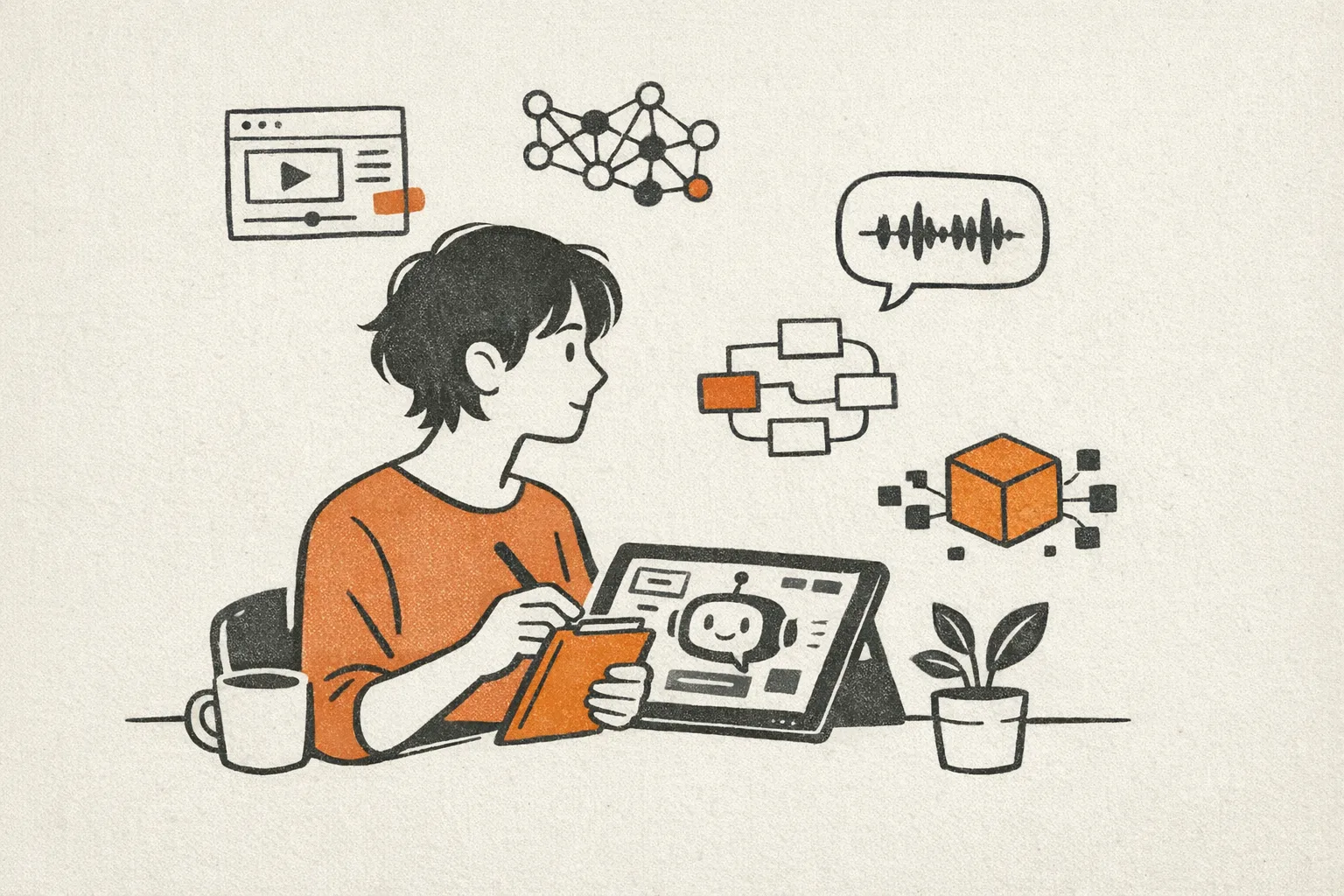
AI jobs for designers: 7 realistic paths to explore in 2026
If you're a designer trying to figure out where AI fits into your career, the good news is you probably do not need to become an ML engineer.
Most designers who pivot successfully into AI-adjacent work do it by bringing the skills they already have: user research, systems thinking, prototyping, visual communication, workflow design, and the ability to make complex tools usable.
The better question is not, "How do I become an AI expert overnight?" It's: which AI-related roles actually value a designer's background?
This guide covers realistic options for UX, UI, product, brand, and visual designers who want to move closer to AI without starting from zero.
What counts as an AI-adjacent role for designers?
An AI-adjacent role is any job where AI is part of the product, workflow, or business model — but the role itself still depends heavily on design judgment.
That can include:
- designing interfaces for AI-powered products
- improving trust, clarity, and usability in AI experiences
- shaping prompts, flows, and outputs
- helping teams explain what an AI system is doing
- creating onboarding, education, and support around new tools
In other words, many companies do not need more people who can train models. They need more people who can make AI products understandable and useful.
Why designers are well positioned for AI work
Designers already solve several problems that AI products tend to have:
- confusing outputs
- weak onboarding
- low user trust
- poor feedback loops
- unclear mental models
- inconsistent interaction patterns
If you've ever simplified a messy product flow, translated technical constraints into user-friendly decisions, or built a portfolio around ambiguous problem-solving, you're already closer than you think.
The strongest pivots usually come from designers who position themselves as the person who can bridge:
- user needs and technical capability
- experimentation and product quality
- speed and trust
- automation and human oversight
1. AI product designer
This is the most direct path for many UX and product designers.
AI product designers work on tools or features where machine-generated output is central to the experience. That might mean designing:
- prompt input flows
- result states
- confidence indicators
- editing and retry patterns
- human-in-the-loop review steps
- onboarding for AI features
Why it's a fit
This role still looks a lot like product design, but with more ambiguity. Teams need designers who can think through edge cases like:
- What happens when the model is wrong?
- How should users correct or refine output?
- When should the system ask for confirmation?
- How do you communicate uncertainty without destroying trust?
What to show in your portfolio
A strong portfolio project here should demonstrate:
- a messy or probabilistic workflow
- multiple output states, not just a happy path
- reasoning about trust and usability
- iteration based on user behavior or feedback
If your current portfolio feels too generic, it may help to first improve how you present your work. See our guide to the best portfolio stack for developers for ideas you can adapt to a design portfolio too, especially around clarity and structure.
2. Conversation designer or prompt UX designer
Some companies split out the work of designing AI interactions into specialized roles. Titles vary, but common versions include:
- conversation designer
- prompt designer
- AI UX writer
- LLM interaction designer
These roles focus on how users communicate with AI systems and how those systems respond.
What the work looks like
You might define:
- prompt templates
- fallback responses
- clarification questions
- tone and voice rules
- error handling
- multi-turn interaction patterns
Why it's a fit
Designers with strengths in UX writing, service design, content design, or interaction design often do well here because the work is less about visual polish and more about flow, comprehension, and behavior.
What helps you stand out
Hiring teams want to see that you can:
- reduce ambiguity in user input
- improve output quality through better interaction design
- create systems, not one-off screens
- think about failure states and recovery
3. Design systems designer for AI products
AI products often ship fast and inconsistently. That creates a big need for designers who can bring order to the chaos.
A design systems role in an AI-heavy company may involve:
- reusable patterns for prompts and outputs
- components for citations, confidence, warnings, and review states
- standards for AI-generated content presentation
- accessibility rules for dynamic or generated interfaces
Why it's a fit
If you enjoy systems thinking, documentation, governance, and cross-functional collaboration, this can be a strong niche.
AI teams often discover that the hard part is not just generating output. It's making the experience consistent enough to scale.
4. UX researcher for AI experiences
AI products create new research questions that many teams are still learning how to answer.
For example:
- When do users trust AI too much?
- When do they ignore useful suggestions?
- What explanations actually improve confidence?
- How do users recover after a bad output?
Designers with a research background can pivot into AI-focused UX research by specializing in these questions.
Why it's a fit
Research becomes especially valuable when product teams are moving fast and making assumptions about user behavior. If you can run studies that reveal where AI helps, confuses, or harms the experience, you become strategically important.
What to emphasize
Frame your experience around:
- ambiguity reduction
- behavioral insight
- experiment design
- trust and comprehension
- decision-making under uncertainty
5. Service designer or workflow designer for AI operations
Not every AI role sits inside a flashy consumer app.
Many companies are using AI inside internal workflows: support operations, content review, sales enablement, healthcare admin, legal intake, recruiting, and more.
These environments need people who can redesign end-to-end systems, not just screens.
What the work looks like
You may map and improve workflows such as:
- where AI suggestions enter a process
- when humans review or override outputs
- how exceptions get handled
- what data or context the system needs
- how teams measure quality and risk
Why it's a fit
Service designers, operations-minded product designers, and UX generalists often have an advantage here because they already think in journeys, handoffs, and constraints.
This path is especially good if you want to move into a more strategic role without becoming purely managerial.
6. AI education, onboarding, or enablement designer
A lot of AI products fail not because the model is weak, but because users do not understand how to use the tool well.
That creates demand for designers who can build:
- onboarding flows
- interactive tutorials
- prompt libraries
- help centers
- templates
- in-product education
Why it's a fit
If you have experience in learning design, product onboarding, documentation, or growth UX, this can be a practical way into AI.
These roles matter because user success in AI products often depends on behavior change. Someone has to design that change.
7. Brand and marketing designer for AI companies
This path is often overlooked, but it's real.
AI startups and established companies alike need designers who can explain complex products clearly across:
- websites
- launch assets
- sales materials
- product marketing visuals
- educational content
- event collateral
Why it's a fit
If your background is more visual, brand, or marketing-oriented, this can be one of the fastest ways to move into the space.
You may not be designing the product itself, but you are still building AI domain knowledge, industry credibility, and a portfolio that can later support a broader pivot.
Which designers have the easiest pivot?
In general, the easiest pivots tend to come from:
- product designers moving into AI product design
- UX writers/content designers moving into prompt or conversation design
- researchers moving into AI UX research
- systems-minded designers moving into AI design systems or workflow design
The harder pivots usually happen when the target role requires a very different craft than your current one.
For example, a brand designer can absolutely move into AI, but may need an intermediate step through product marketing, enablement, or lighter-weight product work before landing a core AI product design role.
Skills to build before you apply
You do not need to master everything. But you should build enough familiarity to speak credibly about AI product work.
Focus on these areas:
1. AI product patterns
Learn common patterns like:
- prompt input and refinement
- generated output review
- citations and source display
- confidence and uncertainty cues
- approval and editing workflows
- retry, regenerate, and compare states
2. Trust and safety basics
Understand issues like:
- hallucinations
- bias
- privacy concerns
- over-reliance
- harmful or low-quality outputs
You do not need to be a policy expert, but you should know why these issues affect design decisions.
3. Rapid prototyping with AI tools
Use current tools enough to form opinions. Try building small concepts, testing prompt structures, and observing where users get stuck.
4. Stronger case-study storytelling
If you're making a pivot, your portfolio has to do more explanatory work than usual. Hiring managers need to understand not just what you designed, but how you think about uncertainty, iteration, and user trust.
How to reposition your portfolio for AI roles
Most designers do not need a full portfolio rebuild. They need a better framing.
A good AI-adjacent portfolio usually includes some combination of:
- one speculative or real AI workflow project
- one case study showing ambiguity or systems thinking
- clear writing about tradeoffs and failure states
- evidence that you understand user trust and product quality
If you are early in the process, create one focused project around a realistic workflow instead of trying to redesign a famous AI app from scratch.
Good examples include:
- an AI assistant for customer support review
- a research summarization workflow
- a content drafting and approval flow
- an internal tool that helps teams classify or triage requests
How to talk about your pivot in interviews
Your story should be simple:
- what kind of designer you are today
- what problems you like solving
- why AI products create more of those problems
- what you've done to build relevant experience
A weak story sounds like: "AI is hot, so I want in."
A stronger story sounds like: "My background is in simplifying complex workflows and improving trust in high-stakes user journeys. AI products amplify those challenges, which is why I've been focusing my portfolio and research there."
A realistic job search strategy
Do not limit yourself to roles with "AI" in the title.
Also search for:
- product designer, AI features
- UX designer, automation
- conversation designer
- content designer, AI
- design systems designer, AI platform
- UX researcher, intelligent systems
- workflow designer, automation
You can also target companies where AI is becoming a major product layer, even if the design team still hires under standard titles.
Final takeaway
The best AI jobs for designers are usually not the ones furthest from design. They're the ones where design becomes more valuable because the product is harder to understand, trust, and use.
If you already know how to reduce complexity, shape workflows, and advocate for users, you likely have more leverage in this market than you think.
The goal is not to become someone else. It's to position your existing strengths where AI creates the most demand for them.
If you're still comparing broader paths, our roundup of the best pivots for software engineers is also useful as a framework for thinking about adjacent-role transitions, even if you're coming from design instead of engineering.
Ready to find your pivot?
Take our 5-minute assessment and get a concrete action plan, tool recommendations, and a 30-day roadmap tailored to your exact situation.
Find Your Pivot