AI Jobs for Game Developers: Best Roles to Pivot Into
Explore the best AI-adjacent jobs for game developers, including product, simulation, tools, and creative tech roles that fit your existing skills.
Ian Cummings
2x Founder, Game Developer
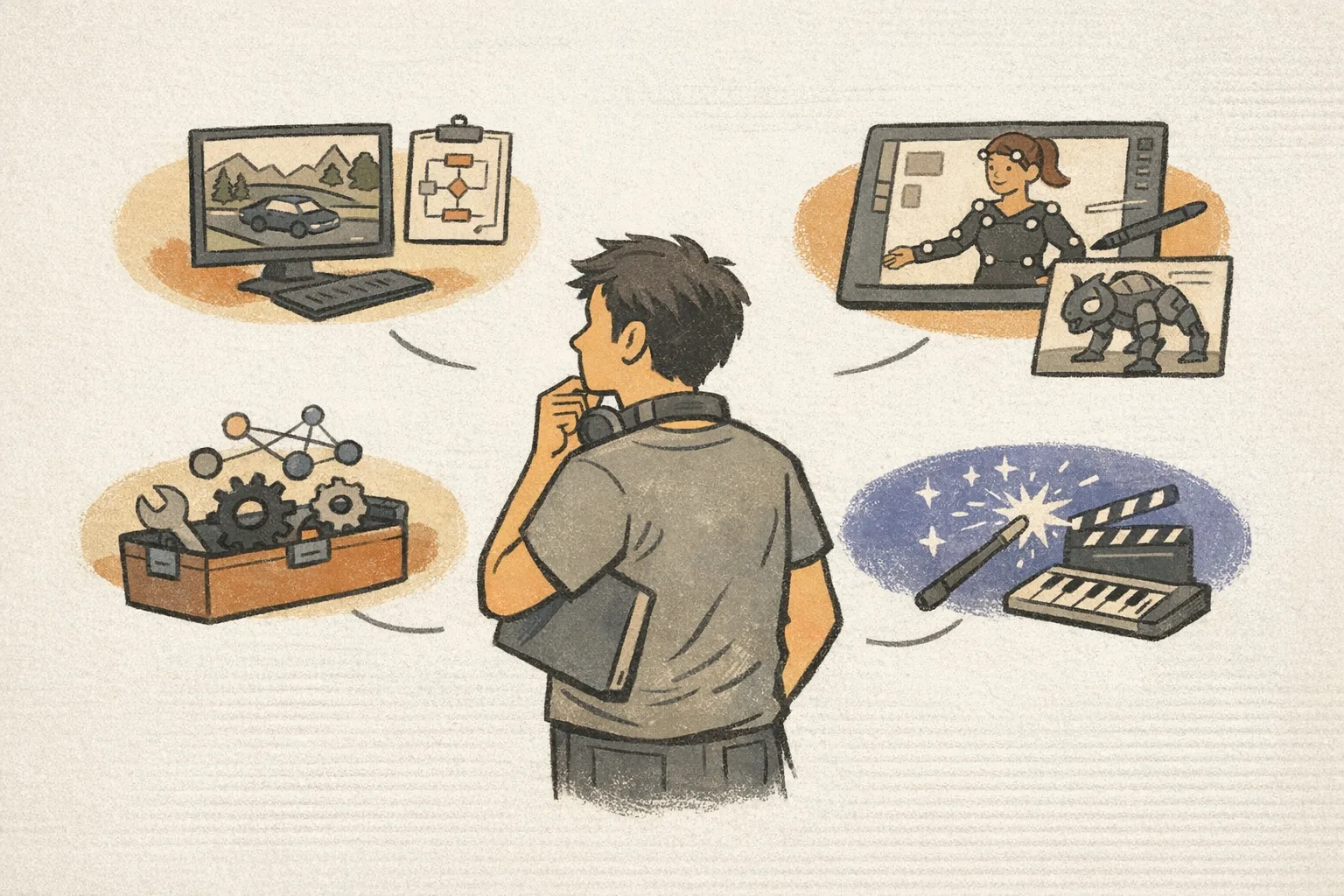
AI jobs for game developers: roles that actually fit your skills
If you're a game developer wondering whether AI is a realistic pivot, the short answer is yes — but usually not in the way social media makes it sound.
Most game developers do not need to become machine learning researchers to move into AI-adjacent work. The better path is often to target roles where your existing strengths already matter: real-time systems, tooling, graphics, simulation, gameplay logic, UX for interactive products, and cross-functional shipping experience.
That matters because a lot of "break into AI" advice is written for data scientists or new grads. If you've already shipped games, engines, tools, or live content, you likely have more transferable leverage than you think.
Why game developers are a strong fit for AI-adjacent work
Game development builds a mix of technical and product instincts that many AI teams need:
- working with complex systems
- building interactive user experiences
- optimizing performance under constraints
- shipping features across design, engineering, and production
- prototyping quickly and iterating from feedback
- handling ambiguity when requirements are still moving
Those skills map especially well to AI products that need more than model training alone. A lot of companies need people who can turn AI capabilities into usable software.
The best AI-adjacent roles for game developers
Here are the roles most likely to fit a game developer without requiring a full reset.
1. AI product engineer
This is often the cleanest pivot.
AI product engineers build user-facing applications powered by models, APIs, agents, or retrieval systems. The work is usually closer to application engineering than pure ML research.
Why game developers fit:
- you're used to building interactive systems
- you can prototype quickly
- you understand event-driven logic and state management
- you've likely worked across engineering, design, and content constraints
Typical work might include:
- building AI-powered creation tools
- integrating LLM features into apps
- designing workflows around prompts, memory, and evaluation
- improving latency, reliability, and UX
If your background is gameplay, tools, UI, or full-stack game services, this role is worth serious attention.
2. Simulation engineer
Simulation is one of the most natural bridges from games into AI.
AI companies working on robotics, autonomy, training environments, synthetic data, or digital twins often need engineers who can build believable, performant virtual environments.
Why game developers fit:
- experience with physics, rendering, and real-time systems
- comfort with engines like Unity or Unreal
- understanding of environment logic, agents, and interactions
- optimization experience for large interactive scenes
This is especially relevant if you've worked on:
- AI behavior systems in games
- procedural generation
- physics-heavy gameplay
- engine or tools programming
3. Technical artist or 3D pipeline engineer for AI tools
Generative AI companies working with image, video, 3D, avatars, or virtual production often need people who understand content pipelines.
Why game developers fit:
- familiarity with asset workflows
- experience bridging art and engineering
- knowledge of shaders, rigging, animation systems, or runtime constraints
- practical understanding of what creators actually need
This can be a strong path for technical artists, graphics programmers, and tools engineers from game studios.
4. Developer tools engineer for AI platforms
A lot of AI companies need internal platforms, SDKs, testing systems, observability, and workflow tooling.
This is less flashy than model work, but often easier to enter.
Why game developers fit:
- tools engineers already solve workflow bottlenecks
- engine and pipeline work translates well to platform thinking
- live-service and build-system experience can be valuable
If you enjoy making other developers faster, this path may be better than chasing an ML title.
5. Applied ML engineer, if you already have the math base
This is the most obvious AI role, but not always the fastest pivot.
If you already have strong Python, linear algebra, statistics, and some hands-on ML experience, applied ML can be realistic. But if you don't, trying to jump straight from gameplay engineering to model training may slow you down.
For many game developers, an AI product or simulation role is the better first move. You can always move deeper into ML later.
Roles that sound promising but are often weaker fits
Some AI roles are possible, but usually require more retraining than people expect.
Pure research roles
These often require advanced academic backgrounds, publications, or deep specialization. If your goal is to pivot efficiently, this is usually not the best first target.
Prompt engineer as a standalone career plan
Prompting matters, but most durable jobs are broader than prompt writing. Companies usually hire for product, engineering, design, or operations roles that include prompting as one skill.
"AI strategist" without direct execution experience
If you come from game development, your edge is building. Lean into that.
How to tell which AI path fits your background
A simple way to narrow your target is to start from the work you've already done.
If you were a gameplay programmer
Look at:
- AI product engineer
- simulation engineer
- interactive prototyping roles
- agent or behavior-system work
If you were an engine or graphics programmer
Look at:
- simulation
- rendering for AI/3D products
- performance engineering
- infrastructure for real-time AI experiences
If you were a tools engineer
Look at:
- developer tools for AI teams
- internal platform engineering
- workflow automation
- evaluation and testing systems
If you were a technical artist
Look at:
- 3D AI tooling
- avatar or animation pipelines
- creative tooling companies
- content operations for generative media products
What to put on your resume for an AI-adjacent pivot
You do not need to rewrite your entire background as if you've always worked in AI.
Instead, translate your experience into outcomes AI hiring managers understand.
For example:
- "Built gameplay systems" becomes "Built interactive real-time systems used by X players"
- "Worked on tools" becomes "Developed internal tooling that reduced iteration time by X%"
- "Optimized performance" becomes "Improved latency, memory usage, or runtime efficiency in complex production environments"
- "Collaborated with design and art" becomes "Shipped cross-functional product features under changing requirements"
The goal is to make your game experience legible, not to disguise it.
What projects help most
The best projects are usually small, specific, and close to the role you want.
Good examples:
- a Unity or Unreal simulation environment for training agents
- an AI-powered level design or content tool
- a small product that uses an LLM API with strong UX and evaluation
- a developer tool for testing prompts, outputs, or workflows
- a 3D or avatar pipeline demo tied to generative tooling
Weak examples:
- another generic chatbot clone
- a course project with no clear user problem
- a large unfinished "AI game platform" idea
A focused project that demonstrates product judgment is usually more useful than a broad demo.
Do you need to learn machine learning first?
Not always.
If you're targeting AI product, simulation, tooling, or creative pipeline roles, you can often start by learning:
- Python basics if you don't already use it
- how model APIs work
- evaluation and reliability concepts
- vector search / retrieval at a practical level
- the constraints of latency, cost, and hallucinations
That is very different from needing a full ML curriculum before applying anywhere.
If you're still deciding between paths, it can help to compare this route with other realistic options in our guide to game developer pivots.
How to know if this pivot is worth it for you
AI-adjacent roles are a strong option if you want:
- a larger job market than traditional game development
- better compensation potential
- more transferable technical experience
- less dependence on a single entertainment niche
They may be a weaker fit if what you love most is game feel, player experience, or building entertainment-first products. In that case, adjacent industries may still be a better move than AI specifically.
A practical 30-day plan
If you want to test this pivot without overcommitting, try this:
- Pick one target role: AI product engineer, simulation engineer, or AI tooling engineer.
- Rewrite your resume around transferable outcomes, not game-specific jargon.
- Build one small project that matches the target role.
- Save 20 job descriptions and highlight repeated requirements.
- Close the top 2 or 3 skill gaps only.
- Start applying before your project feels perfect.
This approach is usually better than spending months "learning AI" in the abstract.
The bottom line
For game developers, the best AI pivot is usually adjacent to AI, not deep inside research.
Your advantage is not that you've used a trendy tool. It's that you've already built complex interactive systems, shipped under constraints, and worked across disciplines.
That's valuable in AI — especially for product, simulation, tooling, and creative technology roles.
If you want a pivot that preserves more of your existing skill stack, start there.
Ready to find your pivot?
Take our 5-minute assessment and get a concrete action plan, tool recommendations, and a 30-day roadmap tailored to your exact situation.
Find Your Pivot