DevOps Engineer AI Role Interview Guide for 2026
A practical interview prep guide for DevOps engineers pivoting into AI-adjacent roles like MLOps, platform engineering, and ML infrastructure.
Ian Cummings
2x Founder, Game Developer
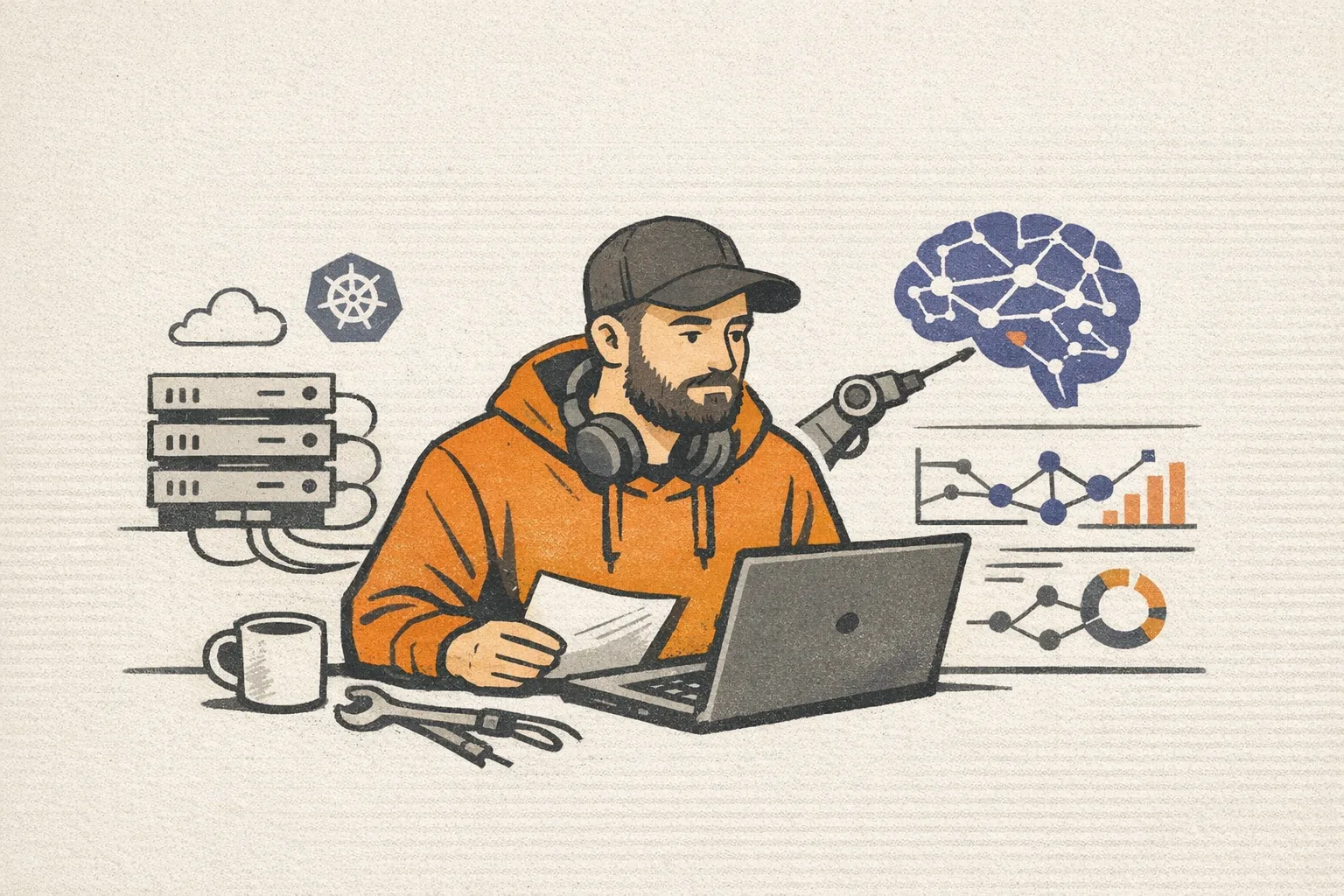
DevOps Engineer AI Role Interview Guide (2026)
If you're a DevOps engineer trying to pivot into a more AI-adjacent role, interview prep is usually where the transition gets real.
A lot of infrastructure engineers already have the core habits these teams need: automation, reliability thinking, observability, incident response, cloud architecture, and cost awareness. The gap is rarely "can you code at all?" It's more often whether you can explain how your DevOps background maps to ML platforms, data infrastructure, internal AI tooling, or production AI systems.
This guide breaks down the interview prep that matters most if you want to move from traditional DevOps work into AI-adjacent roles in 2026.
Which AI-adjacent roles fit DevOps engineers best?
Most DevOps engineers do better targeting adjacent roles than trying to jump straight into pure ML research or model development.
The strongest fits usually include:
- MLOps engineer
- Platform engineer for AI teams
- Site reliability engineer supporting ML systems
- Cloud infrastructure engineer for data or AI workloads
- Developer productivity engineer for AI-enabled engineering orgs
- Solutions engineer or field engineer for AI infrastructure vendors
These roles reward the same strengths that already matter in DevOps:
- building reliable deployment systems
- managing CI/CD and release workflows
- improving observability
- handling secrets, permissions, and compliance
- reducing cloud waste
- designing resilient production systems
If you're still evaluating broader options, you can also review our guide to the best pivots for software engineers.
What interviewers want to hear from DevOps candidates
When hiring managers talk to DevOps engineers for AI-adjacent roles, they are usually listening for three things:
- Can you operate production systems with real reliability standards?
- Can you learn the AI-specific layer without needing to become a research scientist?
- Can you communicate tradeoffs across infrastructure, speed, cost, and risk?
That means your interview prep should not focus on pretending to be an ML expert.
Instead, focus on showing that you can:
- productionize messy workflows
- make experimentation safer and faster
- support GPU or high-compute environments responsibly
- monitor systems with unclear failure modes
- build repeatable deployment and rollback processes
- partner with data scientists and application engineers
The biggest mistake DevOps engineers make in these interviews
The most common mistake is answering every question like it's a generic infrastructure interview.
If the role mentions AI, ML, data platforms, LLM products, or model serving, the interviewer wants to know whether you understand the new operational constraints that come with those systems.
For example:
- model versions may need tracking alongside application versions
- inference latency can behave differently from standard web workloads
- GPU capacity planning is different from CPU autoscaling
- data quality issues can look like application bugs
- prompt changes can affect production behavior even without code changes
- evaluation and rollback may require more than standard deployment checks
You do not need deep research knowledge to discuss these topics. But you do need enough familiarity to sound credible.
The 5 interview topics you should prepare deeply
1. CI/CD for ML and AI systems
You probably already know CI/CD for apps and infrastructure. Now prepare to explain how that thinking extends to AI systems.
Be ready for questions like:
- How would you deploy a model safely?
- What changes in a pipeline when artifacts include models, prompts, or datasets?
- How would you handle rollback?
- What would you test before release?
A strong answer usually mentions:
- artifact versioning
- environment parity
- staged rollouts
- canary deployments
- automated validation checks
- observability after release
- rollback criteria tied to both system health and output quality
You don't need to overcomplicate this. Interviewers mainly want to see that you understand that AI delivery pipelines need the same rigor as software delivery, plus extra checks around data and output behavior.
2. Observability for AI workloads
This is one of the easiest places for DevOps engineers to stand out.
Most candidates can talk about logs, metrics, and traces. Fewer can explain how observability changes when the system includes model inference, vector search, batch pipelines, or prompt-driven behavior.
Prepare examples around:
- latency by model or endpoint
- token or compute cost monitoring
- throughput and queue depth
- failure rates across upstream and downstream services
- drift in request patterns
- user-facing quality signals
- alerting that avoids noisy false positives
A good framing is: traditional observability tells you whether the system is up; AI observability also needs to tell you whether the system is still useful.
3. Cost control and capacity planning
AI infrastructure is expensive, and companies care a lot about engineers who can control spend without blocking progress.
This is a natural advantage for DevOps candidates.
Prepare stories about:
- reducing cloud waste
- right-sizing workloads
- improving utilization
- setting guardrails for experimentation
- balancing reliability with budget
- forecasting infrastructure needs
Then adapt those stories to AI contexts such as:
- GPU scheduling
- batch versus real-time inference tradeoffs
- caching strategies
- model routing
- autoscaling constraints
- vendor lock-in risks
If you've ever saved a team money while improving reliability, that is highly relevant here.
4. Security, compliance, and access control
AI teams often move fast, which creates risk.
Interviewers value DevOps engineers who can support speed without ignoring governance.
Review how you would discuss:
- secret management
- least-privilege access
- auditability
- data handling controls
- environment isolation
- vendor review concerns
- incident response for AI-enabled systems
This matters even more in regulated industries, where AI adoption often depends on whether the infrastructure and security model are trustworthy.
5. Cross-functional communication
A lot of AI-adjacent roles are not purely technical in the interview process.
You may need to explain how you work with:
- data scientists
- ML engineers
- backend engineers
- product managers
- security teams
- finance or procurement stakeholders
Prepare examples where you translated technical constraints into business tradeoffs.
For instance:
- why a faster release path increased reliability
- why a certain architecture reduced cost risk
- why observability investment shortened incident recovery
- why a platform standard helped multiple teams ship faster
This is often what separates senior candidates from mid-level ones.
How to answer: “You don't have direct AI experience”
You should expect some version of this concern.
Don't get defensive. Reframe it.
A strong response sounds like this:
- acknowledge the gap honestly
- show what is already transferable
- point to specific AI concepts you've studied or practiced
- explain how you've ramped quickly in adjacent domains before
- connect your background to the team's current bottlenecks
Example structure:
My background is in production infrastructure, reliability, and delivery systems rather than model development itself. But the problems your team is hiring for — deployment safety, observability, cost control, and platform maturity — are exactly the kinds of systems problems I've solved before. I've been building enough familiarity with model serving, evaluation, and AI-specific operational tradeoffs to contribute in this environment without needing to be a researcher.
That answer is usually much stronger than trying to oversell shallow AI experience.
A practical prep plan for the next 2 weeks
If you want interviews soon, don't try to learn everything.
Use a focused prep plan.
Days 1–3: map your experience
Write down 6 to 8 projects from your DevOps background that show:
- automation
- reliability
- cloud architecture
- incident response
- cost optimization
- security controls
- platform improvements
Then rewrite each one in terms relevant to AI-adjacent teams.
Days 4–6: learn the missing vocabulary
You should be comfortable discussing:
- model serving
- inference
- batch vs real-time pipelines
- feature or data pipelines
- vector databases at a high level
- evaluation basics
- drift and monitoring concepts
- GPU constraints
You do not need to become an expert. You just need enough fluency to avoid sounding unfamiliar.
Days 7–10: build one small proof-of-work project
A lightweight project helps a lot.
Examples:
- deploy a simple inference API
- create a CI/CD pipeline for an AI demo app
- add monitoring to an LLM-based internal tool
- containerize and deploy a small retrieval app
- build Terraform for a toy AI workload
The project matters less than your ability to explain the design decisions.
Days 11–14: practice interview answers out loud
Prepare concise answers for:
- Tell me about yourself.
- Why this role?
- Why move from DevOps into AI-adjacent work?
- How would you productionize an ML or LLM service?
- How do you think about reliability for AI systems?
- How do you control infrastructure cost?
- What would your first 30 days look like?
Keep your answers concrete and operational.
What to put in your portfolio or resume before applying
If you're making this pivot, your resume should not read like a generic DevOps profile.
Update it to emphasize:
- platform ownership
- production reliability
- deployment automation
- observability systems
- cloud cost improvements
- security and compliance work
- collaboration with engineering teams
If possible, add one line that signals AI adjacency, such as:
- supported data or ML infrastructure
- deployed inference or API workloads
- built internal tooling used by AI teams
- improved observability for model-backed services
Even one credible project can help recruiters understand the direction of your pivot.
Roles and industries where this pivot is easiest
DevOps engineers often have the smoothest transition into AI-adjacent work in environments that already value infrastructure maturity.
That usually includes:
- cloud platforms
- developer tools companies
- cybersecurity vendors
- data infrastructure companies
- enterprise SaaS teams adopting AI features
- consulting firms building internal AI platforms
- regulated industries that need secure AI deployment
These employers are often less focused on pure ML pedigree and more focused on whether someone can make systems reliable in production.
Final takeaway
If you're a DevOps engineer, you do not need to become a machine learning researcher to move into AI-adjacent work.
Your edge is operational judgment.
The best interview prep is not memorizing AI buzzwords. It's learning just enough of the domain to connect your existing strengths to the problems these teams actually have: shipping safely, scaling responsibly, controlling cost, and keeping production systems trustworthy.
That's a real pivot path in 2026 — and for many DevOps engineers, it's one of the most realistic ones.
If you want a broader starting point beyond interview prep, visit our career guide for DevOps engineers exploring their next pivot.
Ready to find your pivot?
Take our 5-minute assessment and get a concrete action plan, tool recommendations, and a 30-day roadmap tailored to your exact situation.
Find Your Pivot