Frontend Developer Portfolio and Interview Prep for AI Roles
How frontend developers can update portfolios and interview prep for AI-adjacent roles in 2026 without pretending to be ML engineers.
Ian Cummings
2x Founder, Game Developer
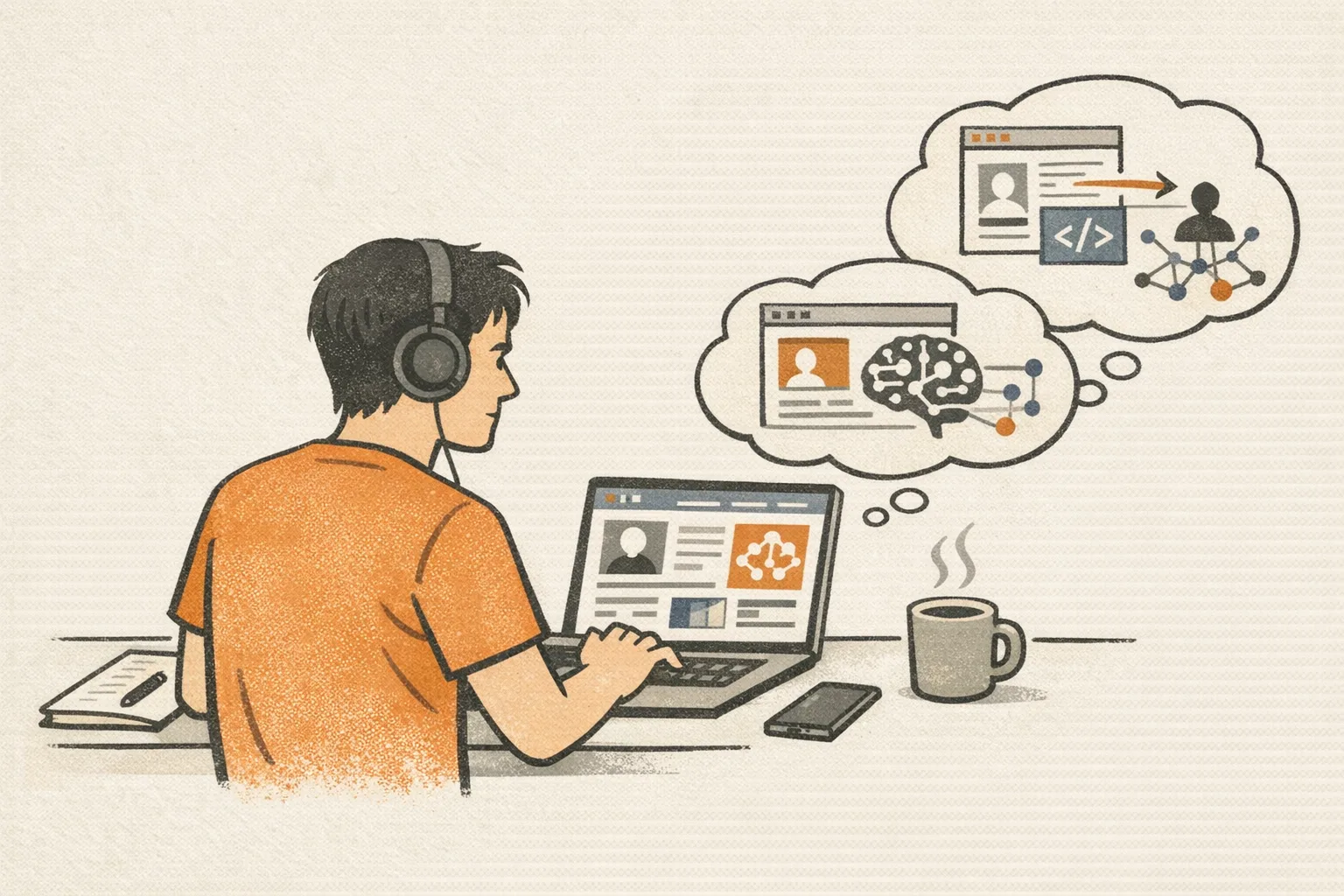
Frontend Developer Portfolio and Interview Prep for AI-Adjacent Roles in 2026
If you're a frontend developer trying to stay employable in 2026, you do not need to become an ML engineer overnight. A more realistic move is to position yourself for AI-adjacent roles: jobs where companies still need strong product UI, design systems, dashboards, onboarding flows, internal tools, and customer-facing web apps around AI features.
That means your edge is not "I can train models." Your edge is "I can make AI products usable, trustworthy, fast, and shippable."
This guide covers how frontend developers can update their portfolio, resume story, and interview prep for AI-adjacent roles without pretending to be something they're not.
What counts as an AI-adjacent role for frontend developers?
For frontend developers, AI-adjacent roles usually sit close to product delivery rather than model research. Examples include:
- Frontend engineer on an AI product team
- Product engineer building AI-powered workflows
- Design systems engineer supporting AI features across apps
- Full-stack leaning frontend developer for internal AI tools
- Developer experience engineer for AI platforms or APIs
- Solutions engineer building demos and customer-facing prototypes
These roles still reward the same core frontend strengths:
- Clear UI architecture
- Strong React, TypeScript, and state management fundamentals
- Performance optimization
- Accessibility
- API integration
- Collaboration with product, design, and backend teams
The difference is that employers now want proof you can handle the UX and engineering challenges that show up when software includes AI outputs.
The portfolio shift: show AI product thinking, not just polished UI
A generic frontend portfolio often over-indexes on visuals: landing pages, clone projects, and clean component work. That is still useful, but AI-adjacent hiring managers usually want to see whether you can build interfaces around uncertainty.
AI features create product problems like:
- Inconsistent outputs
- Long-running requests and streaming states
- Confidence and trust issues
- Human review workflows
- Error recovery when the model fails
- Permissioning, privacy, and auditability concerns
A strong frontend portfolio project should demonstrate that you can design and build for those realities.
What to include in an AI-adjacent frontend portfolio project
If you are creating or refreshing portfolio pieces, prioritize projects that show these patterns.
1. Input-heavy workflows
Build something where users provide structured input, not just click around a static UI.
Examples:
- Prompt configuration panel
- Content generation workflow
- Search and summarization interface
- Support agent workspace
- Document review tool
This shows you can think through forms, validation, state transitions, and user guidance.
2. Output review and editing
Do not stop at "user submits prompt, model returns text." Add a review layer.
Examples:
- Accept / reject / regenerate actions
- Side-by-side comparison of outputs
- Inline editing before publish
- Highlighted citations or source references
- Feedback capture on output quality
This is one of the clearest signals that you understand real AI product UX.
3. Loading, streaming, and failure states
Many frontend portfolios ignore edge cases. AI-adjacent teams care about them.
Show:
- Streaming responses
- Skeleton states
- Retry flows
- Timeouts
- Partial results
- Empty states with useful guidance
A hiring manager should be able to tell that you know how to make an unreliable system feel usable.
4. Metrics or admin views
Internal tools and operational dashboards are common in AI-adjacent companies.
A project gets stronger if it includes:
- Usage analytics views
- Review queues
- Moderation tools
- Cost or latency dashboards
- Role-based UI states
This helps you look relevant for product engineering and internal platform work, not just marketing-site frontend.
Three portfolio project ideas that fit this market
You do not need ten projects. Two or three focused ones are enough if they tell the right story.
AI support copilot dashboard
Build a support workspace where an agent can:
- See suggested replies
- Edit drafts
- View customer context
- Approve or discard AI output
- Track confidence or source references
Why it works: it combines tables, detail panes, async states, and human-in-the-loop UX.
Document summarization and review app
Build a tool where users upload a document, receive a summary, and then review extracted action items or risks.
Why it works: it shows file handling, long-running jobs, output review, and trust-oriented UI.
Internal prompt testing console
Build an internal tool for comparing prompt versions or model outputs across test cases.
Why it works: it looks like the kind of practical tooling many startups and platform teams actually need.
How to describe your frontend work so it sounds relevant
A lot of frontend developers undersell themselves by describing only implementation details.
Weak framing:
- Built React components for dashboard
- Integrated API responses into UI
- Improved page performance
Stronger framing:
- Designed a review workflow for AI-generated outputs, including retry, edit, and approval states
- Built a streaming interface for long-running generation tasks with clear loading and failure handling
- Created reusable UI patterns for confidence indicators, citations, and human override actions
- Reduced friction in a multi-step workflow by simplifying state transitions and validation
The second set sounds closer to product impact and AI-adjacent relevance.
Resume tweaks that help frontend developers pivot
Your resume does not need to claim deep AI expertise. It should make your existing experience legible to teams hiring around AI products.
Focus on bullets that emphasize:
- Complex workflows
- Data-heavy interfaces
- Internal tools n- API integration
- Experimentation and iteration
- Cross-functional work with product and design
- Performance and accessibility in high-usage apps
If you have touched any of the following, move them up:
- Search
- Recommendations
- Personalization
- Analytics dashboards
- Workflow automation
- Content moderation
- Knowledge base interfaces
- Chat or messaging UI
Those experiences map well to AI-adjacent product work.
Interview prep: what frontend developers should expect
For AI-adjacent roles, frontend interviews usually still test standard engineering fundamentals. You should expect some mix of:
- JavaScript and TypeScript fundamentals
- React architecture
- State management decisions
- API integration patterns
- UI performance
- Accessibility
- System design for frontend applications
But you may also get product-oriented questions about AI features.
Examples:
- How would you design a chat interface that streams responses?
- How would you handle unreliable or low-confidence outputs in the UI?
- What should happen if generation takes 20 seconds?
- How would you help users verify whether an answer is trustworthy?
- How would you instrument an AI workflow to learn where users get stuck?
These are not ML questions. They are frontend product engineering questions.
A simple framework for answering AI-adjacent interview questions
When asked to design or critique an AI-powered interface, structure your answer around five areas:
- User goal
- Input design
- Output handling
- Failure and trust states
- Measurement
For example:
- User goal: What is the user trying to accomplish quickly?
- Input design: What context or constraints should the UI collect?
- Output handling: How should results be displayed, edited, or compared?
- Failure and trust states: What if the output is wrong, slow, or incomplete?
- Measurement: What events would you track to improve the workflow?
This framework helps you sound practical and senior, even if you have not worked on a dedicated AI team before.
What hiring managers want to hear from frontend candidates
They usually want confidence in three things:
You can ship product, not just components
Talk about decisions, tradeoffs, and user outcomes.
You can handle ambiguity
AI features are messy. Show that you can work through unclear requirements and evolving behavior.
You understand trust and usability
The best frontend candidates for AI-adjacent roles think beyond "does it render?" They think about whether users can rely on the experience.
Common mistakes frontend developers make when pivoting
Avoid these:
- Pretending to be an AI engineer when you are applying for frontend roles
- Filling your portfolio with toy chatbot clones
- Ignoring error states and review workflows
- Talking only about frameworks instead of product outcomes
- Leaving out internal tools or operational UI work because it feels less glamorous
In this market, practical product engineering often beats flashy demos.
A better positioning statement for your job search
Instead of saying:
"I'm a frontend developer trying to get into AI."
Try something like:
"I'm a frontend engineer focused on building usable, trustworthy product experiences around complex backend systems, including AI-powered workflows."
That positioning is more credible and more useful.
Where this fits in your broader pivot strategy
If you are exploring adjacent options beyond pure frontend roles, it can also help to look at product engineering, solutions engineering, developer experience, and internal tools work. Those paths often value the same communication and UI strengths while giving you more exposure to AI-related products.
You can also review our guide to AI-adjacent roles for frontend developers if you want a broader map of role options, or go straight to the frontend developers pivot page to assess which direction fits your background.
Final takeaway
Frontend developers do not need to outcompete ML specialists to stay relevant. They need to show they can make AI-powered products usable in the real world.
That means your portfolio and interview prep should emphasize:
- Workflow design
- Async and failure-state handling
- Trust-oriented UI patterns
- Human review and editing
- Clear product thinking
If you can demonstrate those skills clearly, you will look much more credible for AI-adjacent roles in 2026 than candidates who only added a chatbot demo to their portfolio.
Ready to find your pivot?
Take our 5-minute assessment and get a concrete action plan, tool recommendations, and a 30-day roadmap tailored to your exact situation.
Find Your Pivot