Game Developer Portfolio and Interview Prep for AI Roles
How game developers can reposition portfolios and interview stories for AI-adjacent roles with practical examples and project ideas for 2026.
Ian Cummings
2x Founder, Game Developer
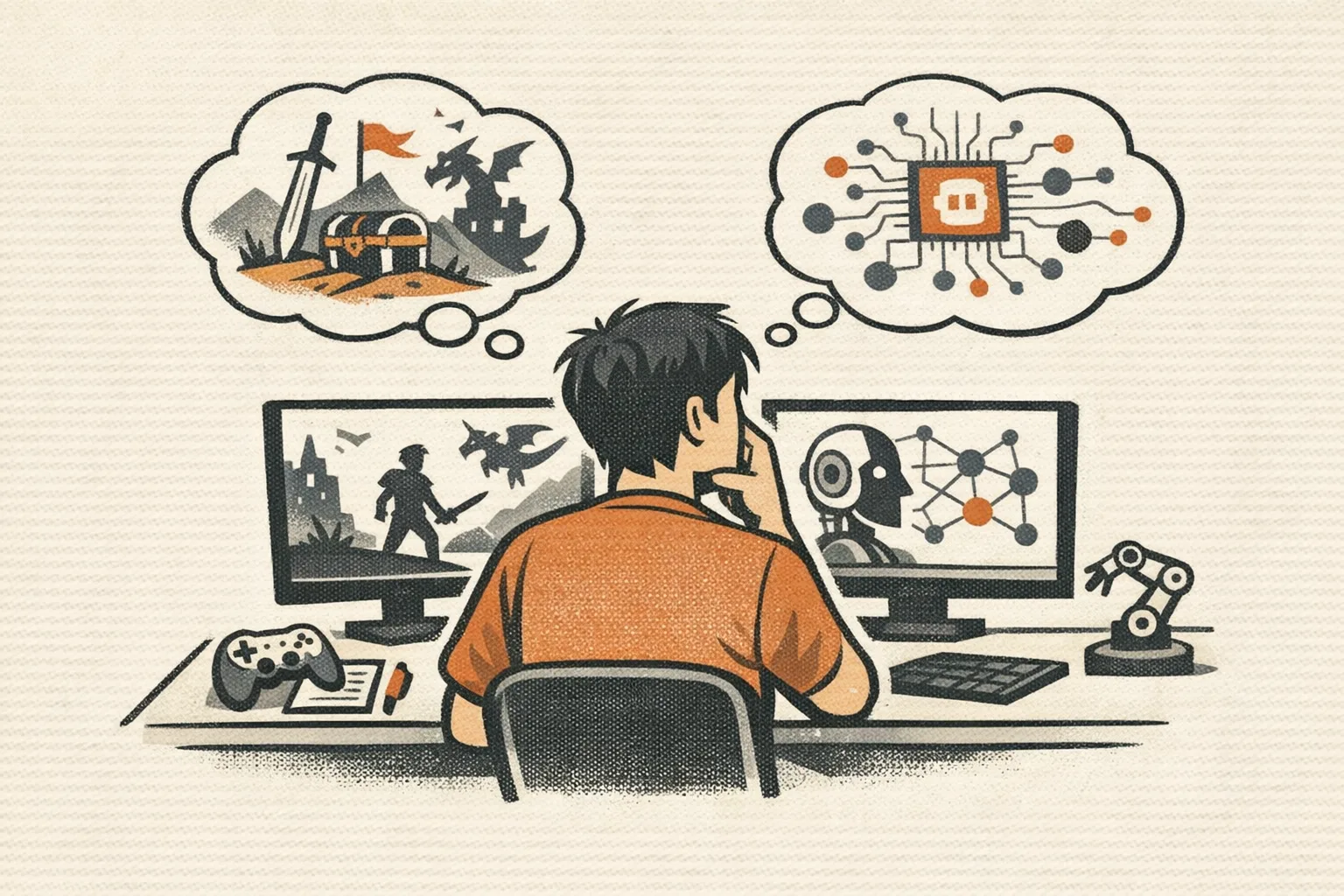
Game developer portfolio and interview prep for AI-adjacent roles
If you're a game developer trying to pivot into AI-adjacent work, your biggest problem usually isn't raw ability. It's translation.
You may already know how to ship features, work across design and engineering, debug messy systems, and make tradeoffs under deadline pressure. But hiring managers outside games do not automatically understand how engine work, gameplay systems, tooling, live ops, or technical design map to roles in AI products.
That means your portfolio and interview prep matter more than usual.
This guide covers how game developers can reposition their experience for AI-adjacent roles in 2026, what to include in a portfolio, how to talk about game work in interviews, and which proof points help you look credible even if you have never held an "AI" title.
If you want a broader overview first, start with our guide for frontend developers pivoting in 2026.
What counts as an AI-adjacent role for game developers?
For most game developers, the most realistic first step is not becoming an ML researcher. It's moving into roles where your existing product, systems, and implementation skills still matter.
Examples include:
- product engineer on AI-powered features
- frontend or full-stack engineer for AI applications
- developer tools engineer for AI workflows
- QA or evaluation-focused roles for model behavior and output quality
- solutions engineer or prototyping engineer for AI products
- technical designer or prompt workflow builder on internal AI tooling
These roles often reward people who can:
- build fast prototypes
- reason about user experience
- handle ambiguous requirements
- test edge cases
- work with imperfect systems
- collaborate with artists, designers, PMs, and engineers
Game developers often do all of that already.
The portfolio mistake most game developers make
The most common mistake is leading with game-specific identity instead of transferable outcomes.
A portfolio that says:
- "Gameplay Programmer"
- "Unreal generalist"
- "Built combat systems"
- "Worked on enemy AI"
may be accurate, but it does not help a non-game employer quickly understand where you fit.
Instead, frame projects around problems solved:
- built interactive systems under performance constraints
- designed tools that improved team workflow
- created content pipelines that reduced manual work
- implemented stateful UI and debugging workflows
- tested complex edge cases across many user paths
- shipped features with measurable player or team impact
The goal is not to hide your game background. The goal is to make it legible.
What to include in a pivot-ready portfolio
You do not need ten polished projects. You need a small number of relevant examples that prove you can work in adjacent environments.
A strong portfolio for AI-adjacent roles usually includes:
- 1 to 2 shipped game projects or substantial game systems
- 1 to 2 non-game projects that show transferability
- clear writeups explaining decisions, constraints, and outcomes
- evidence of collaboration, iteration, and debugging
- a simple explanation of your target role
Think in terms of proof, not volume.
The best project types to add if you're pivoting now
If your current portfolio is entirely game-focused, add one or two projects that reduce hiring risk.
Good options:
1. An AI feature wrapper
Build a small app that uses an existing model API to solve a narrow user problem.
Examples:
- NPC dialogue testing sandbox
- quest text summarizer for writers
- bug triage assistant for live ops notes
- player feedback clustering dashboard
- item description generator with human review flow
This shows you can build around AI systems even if you are not training models.
2. An evaluation or QA workflow project
Game developers often underestimate how valuable testing instincts are.
Build a project that compares outputs, tracks failure cases, or creates review workflows.
Examples:
- rubric-based response review tool
- prompt/version comparison interface
- annotation workflow for output quality checks
- edge-case test harness for structured outputs
This is especially useful if you're considering evaluation-heavy roles.
3. A tools or pipeline project
Internal tools experience transfers well.
Examples:
- asset tagging workflow
- content ops dashboard
- batch processing tool
- editor extension
- automation script with clear before/after impact
AI companies still need people who can improve workflows, not just model performance.
How to rewrite game projects so recruiters understand them
For each project, use a simple structure:
- problem
- constraints
- what you owned
- technical decisions
- result
- what this proves for your target role
For example, instead of:
"Implemented behavior tree system for enemy encounters."
Try:
"Built and iterated on a state-driven encounter system used across multiple combat scenarios. Worked within performance and content-production constraints, added debugging hooks for designers, and reduced iteration time for tuning encounter behavior. This project demonstrates systems thinking, cross-functional tooling, and shipping under ambiguity."
That version is easier for non-game teams to map to product engineering, tooling, or AI workflow roles.
What hiring managers want to hear in interviews
In interviews, game developers often go too deep on engine details too early.
Technical depth is good, but first establish relevance.
Hiring managers usually want to know:
- can you solve messy product problems?
- can you work with users or internal stakeholders?
- can you ship with imperfect information?
- can you debug failures systematically?
- can you explain tradeoffs clearly?
- can you learn a new domain without drama?
Your interview stories should answer those questions.
The 5 stories you should prepare
Before applying, prepare these five stories from your game background:
1. A project with ambiguity
Describe a time requirements were unclear and you still moved the work forward.
2. A debugging story
Explain a difficult bug, how you isolated it, and how you verified the fix.
3. A collaboration story
Show how you worked with design, art, production, QA, or stakeholders with different priorities.
4. A tradeoff story
Talk about choosing between speed, quality, scope, performance, or maintainability.
5. A user-impact story
Even if you worked on internal systems, explain who benefited and how.
These stories are more useful than trying to sound like an AI expert.
How to answer: "Why are you leaving games?"
This question comes up a lot, and weak answers create risk.
Avoid answers that sound purely negative, like:
- games are unstable
- pay is bad
- I'm burned out
- I just want to try AI because it's hot
Those things may be true, but they should not be the center of your answer.
A stronger version:
"I want to apply the parts of game development I'm best at—interactive systems, rapid iteration, cross-functional collaboration, and user-focused problem solving—in a space with broader product opportunities. AI-adjacent roles feel like a strong fit because they still reward experimentation, systems thinking, and shipping useful experiences."
That keeps the story forward-looking.
How technical do you need to be?
It depends on the role.
For product engineering roles, you usually need enough technical depth to build features, integrate APIs, reason about data flow, and maintain production code.
For evaluation, QA, or operations-heavy roles, you may need less algorithmic depth and more strength in:
- test design
- structured thinking
- documentation
- pattern recognition
- workflow design
- communication
If you're still exploring, our post on AI-adjacent jobs for DevOps engineers is another useful example of how adjacent technical backgrounds can be repositioned.
A simple portfolio homepage structure
If you need a fast reset, use this structure:
Headline
Game developer pivoting into AI-adjacent product, tooling, or evaluation roles.
Short intro
2 to 3 sentences on your background, strengths, and target roles.
Featured projects
Show 3 to 4 projects max.
For each one, include:
- one-sentence summary
- stack or tools used
- what you owned
- measurable or observable outcome
- link to demo, repo, or writeup
Skills section
Keep this grouped by function, not giant keyword spam.
Example groups:
- product engineering
- tools and pipelines
- testing and debugging
- engines and frameworks
- collaboration and workflow
Target roles
Spell them out directly.
Examples:
- product engineer, AI applications
- technical QA or model evaluation
- developer tools engineer
- prototyping engineer
Clarity helps people route you correctly.
What if you don't have direct AI project experience yet?
That's normal.
You do not need to pretend you have deep AI experience. You need to show proximity and readiness.
You can do that by demonstrating:
- comfort with APIs and integrations
- ability to evaluate output quality
- strong product instincts
- workflow automation experience
- fast learning in new technical environments
A small, well-explained project is better than inflated claims.
Where game developers often have an edge
Compared with many candidates, game developers often bring:
- stronger real-time interaction instincts
- better tolerance for ambiguity
- more experience balancing technical and creative constraints
- practical optimization habits
- deeper iteration loops with user experience in mind
Those are real advantages in AI-adjacent teams, especially early-stage ones.
Final takeaway
If you're a game developer trying to pivot, your portfolio and interview prep should do one thing well: make your experience easy to translate.
You are not starting from zero. You are packaging existing strengths for a different market.
Focus on relevant proof, clear framing, and a few strong stories. That is often enough to get traction in AI-adjacent roles without waiting to become a perfect candidate.
If you want a role-specific next step, explore the broader paths on our game developers pivot page.
Ready to find your pivot?
Take our 5-minute assessment and get a concrete action plan, tool recommendations, and a 30-day roadmap tailored to your exact situation.
Find Your Pivot