Game Developer Portfolio for AI Jobs: What to Show
Learn how game developers can position portfolios for AI-adjacent roles with better project framing, clearer outcomes, and stronger interview alignment.
Ian Cummings
2x Founder, Game Developer
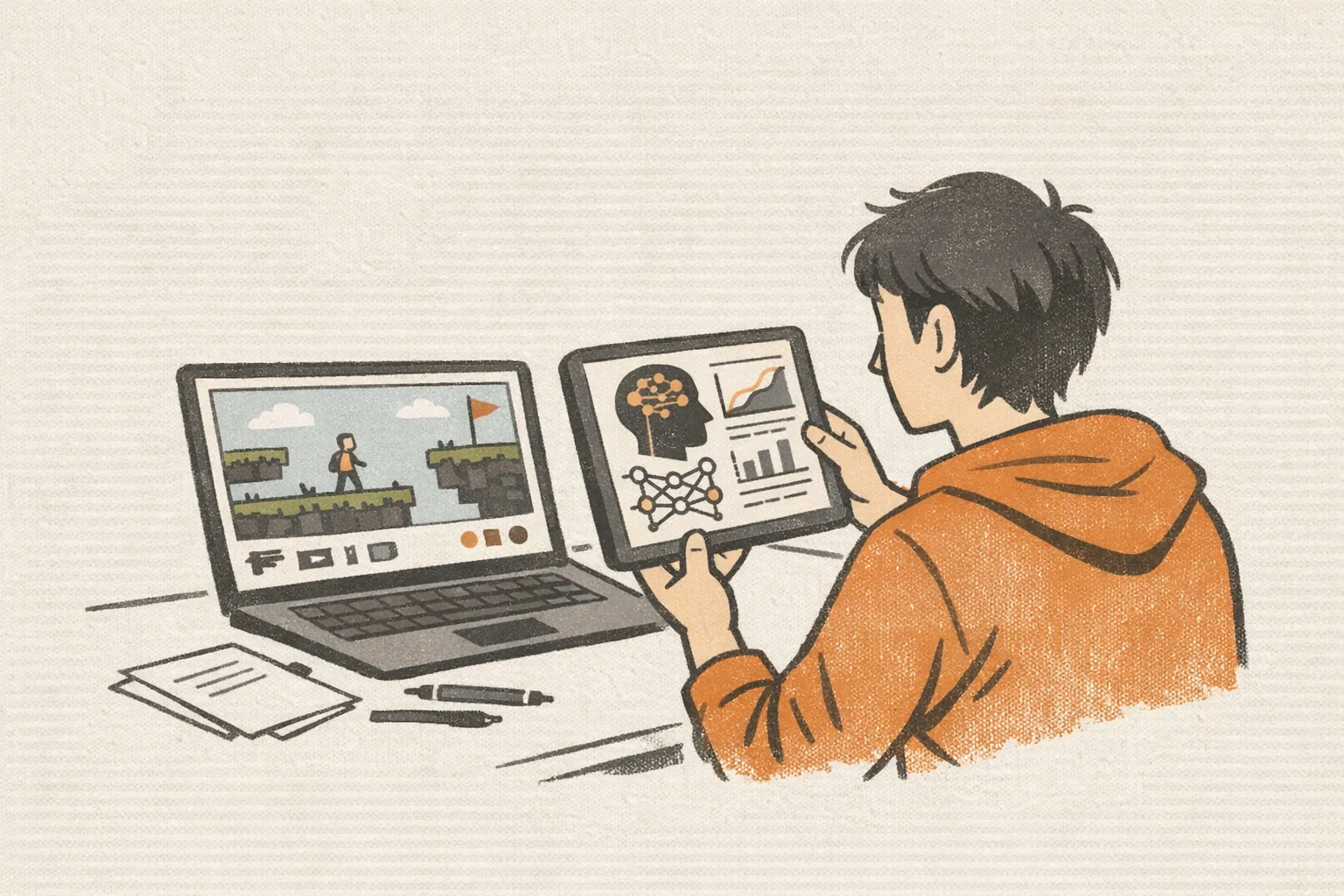
Game Developer Portfolio for AI Jobs
If you're a game developer trying to move into AI-adjacent work, your portfolio matters more than your resume summary.
A lot of game engineers already have relevant experience: real-time systems, tooling, simulation, optimization, data pipelines, gameplay AI, and cross-functional collaboration. The problem is that most portfolios present that work in game-industry language, while hiring managers for AI roles are scanning for evidence that you can solve product, platform, or applied ML-adjacent problems.
This guide shows how to reframe your portfolio so recruiters and hiring managers can quickly understand why your background fits AI-related roles.
Start with the roles you're actually targeting
Before you rewrite your portfolio, pick 2 or 3 role families.
For most game developers, the realistic AI-adjacent targets are:
- AI product engineer
- ML platform or infrastructure engineer
- data or simulation engineer
- developer tools engineer
- backend engineer on AI products
- technical artist or tools-focused pipeline roles, depending on your background
If you're still exploring, start with our guide to AI jobs for game developers.
Your portfolio should make a clear case for one of these paths. If it tries to speak to every possible job, it usually becomes too vague to help.
Translate game work into business-readable outcomes
One of the biggest mistakes game developers make is assuming everyone understands the value of their previous work.
A bullet like this is too insider-heavy:
- Built behavior tree tooling for enemy AI across multiple combat scenarios
That may be impressive, but outside games it can be hard to map.
A stronger portfolio description explains the problem, system, and result:
- Built internal tooling for designing and testing decision logic across complex real-time scenarios, reducing iteration time for designers and improving reliability of gameplay systems
You are not changing the truth. You are making the value legible.
Good translation patterns include:
- gameplay systems -> real-time application logic
- engine optimization -> performance engineering
- build pipeline work -> developer productivity and CI/CD improvements
- telemetry or analytics work -> data instrumentation and experimentation support
- NPC or agent behavior work -> decision systems, simulation, or rule-based automation
- content pipeline tooling -> workflow automation and internal platform engineering
Lead with projects that look adjacent to AI work
You do not need to have trained a large model to be a credible candidate.
But you do need portfolio projects that feel directionally relevant.
The strongest projects usually show one or more of these:
- working with messy data
- building tools used by other people
- evaluating system quality with metrics
- creating automation that reduces manual work
- integrating APIs or model-powered features into a product
- handling performance, scale, or reliability constraints
For example, a game developer portfolio project could be:
- a simulation tool for balancing systems
- a content tagging or search workflow
- a moderation or classification prototype
- an internal assistant for designers using an LLM API
- a telemetry dashboard that helps teams analyze player behavior
- a procedural generation tool with measurable output quality
These projects help employers see that you can operate near AI systems even if your title has never included "ML."
Show your thinking, not just screenshots
A lot of portfolios in games rely heavily on visuals. That can help, but for AI-adjacent roles, written explanation is often what gets you interviews.
For each project, include:
- the problem
- your role
- the technical constraints
- the architecture or workflow
- the tradeoffs you made
- how success was measured
- what you would improve next
A simple structure works well:
- Context
- Problem
- Approach
- Technical decisions
- Outcome
- Lessons learned
This format makes it easier for hiring managers to imagine you working on ambiguous, cross-functional problems.
Include one project that is explicitly AI-adjacent
If you're pivoting now, build at least one project that clearly connects your background to the market you want.
It does not need to be huge. It does need to be specific.
Good examples:
- a Unity or Unreal tool that uses an LLM API to generate quest, dialogue, or test content with human review
- a retrieval-based knowledge assistant for design docs or game systems documentation
- an evaluation harness comparing prompt or model outputs against simple quality criteria
- a pipeline that classifies, tags, or summarizes player feedback
- a small agent workflow that automates repetitive production tasks
The goal is not to impress people with buzzwords. The goal is to prove that you can scope, build, and explain a useful system.
Make your portfolio readable for non-game recruiters
Many first-pass reviewers will not come from games.
That means your portfolio homepage should quickly answer:
- What kind of roles are you targeting?
- What technical strengths do you bring?
- Which projects are most relevant?
- Why are you a fit for AI-adjacent work?
A strong intro can be simple:
"Game developer with experience in real-time systems, tooling, and cross-functional product development. Currently targeting AI-adjacent engineering roles across developer tools, backend systems, and applied product workflows."
That framing is much more useful than a generic statement about being passionate about technology.
Prepare for portfolio-driven interview questions
Your portfolio is not just for applications. It also shapes the interview.
Expect questions like:
- Why are you moving from games into AI-related work?
- Which of your projects best demonstrates relevant experience?
- How have you worked with data, automation, or intelligent systems?
- What tradeoffs did you make in your architecture?
- How do you evaluate whether a system is actually useful?
If your portfolio already answers these questions, interviews become easier.
This is especially important if you're competing against candidates with more direct AI branding but less depth in shipping real products.
Common portfolio mistakes game developers should avoid
Watch out for these issues:
- too much jargon without explanation
- too many screenshots and not enough technical detail
- listing responsibilities without outcomes
- presenting only game-specific work when targeting broader roles
- including unfinished experiments with no clear takeaway
- making the AI project a toy demo with no user or workflow context
Your portfolio should reduce uncertainty for employers. If they have to guess how your experience transfers, you are making the pivot harder than it needs to be.
A simple portfolio checklist
Before you start applying, make sure you have:
- a clear target role or role family
- a short headline that explains your pivot
- 2 to 4 strong projects, not 10 shallow ones
- at least one explicitly AI-adjacent project
- outcome-focused descriptions for each project
- links to code, demos, or writeups where appropriate
- language that a non-game hiring manager can understand quickly
Final thought
Game developers often undersell how transferable their skills are.
If you've built systems under performance constraints, collaborated across disciplines, created tools, and shipped complex interactive products, you already have a strong base for many AI-adjacent roles.
The portfolio's job is to make that transfer obvious.
If you want help narrowing your next move, start with the career pivot quiz and compare your options before rewriting your materials.
Ready to find your pivot?
Take our 5-minute assessment and get a concrete action plan, tool recommendations, and a 30-day roadmap tailored to your exact situation.
Find Your Pivot